Kapden Team — December 20, 2025
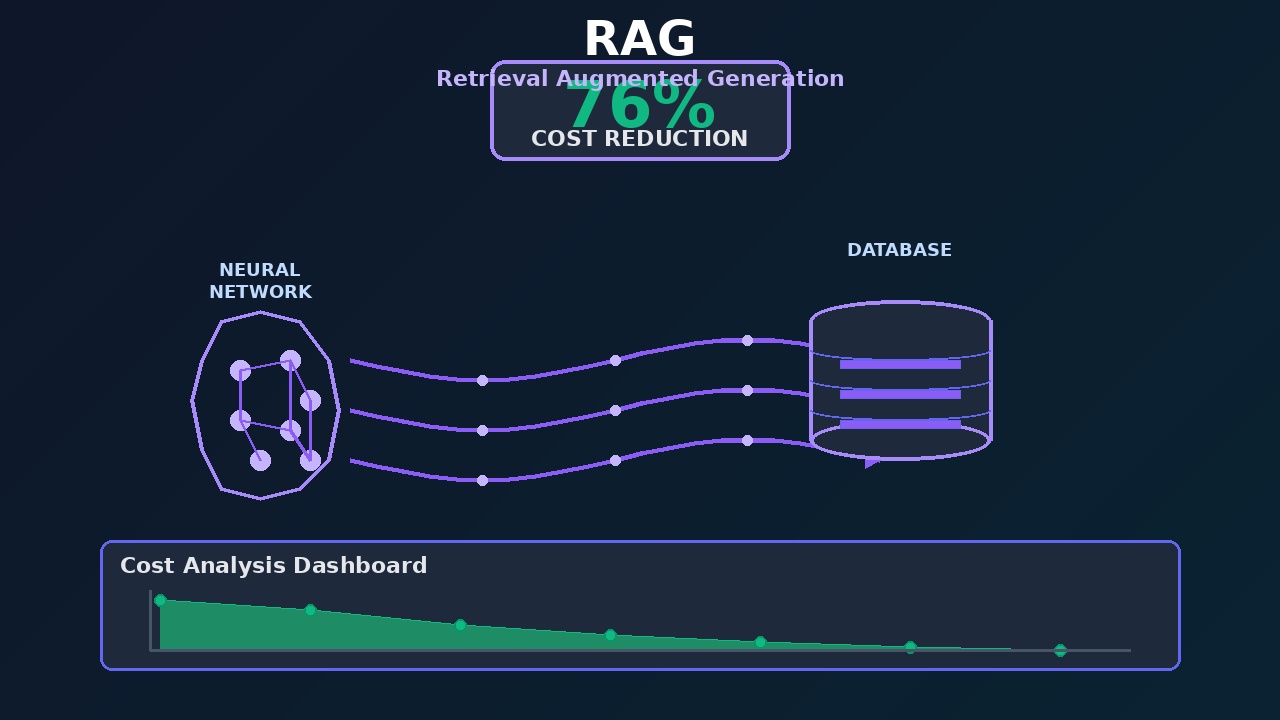
An AI-powered customer service platform was spending $92,000 monthly on LLM API calls while struggling with slow response times and accuracy issues. By implementing Retrieval-Augmented Generation (RAG) architecture, we reduced their LLM costs by 76% to $22,000 monthly, improved response accuracy by 34%, and cut average response time by 58%.
Results Overview
Cost Optimization
| Cost Category | Before (Naive) | After (RAG) | Savings |
|---|---|---|---|
| LLM API Calls | $92,000/mo | $22,000/mo | 76% reduction |
| Average Tokens/Request | 85,000 | 8,500 | 90% reduction |
| Embedding Generation | $0 | $1,800/mo | New cost |
| Vector Database | $0 | $2,400/mo | New cost |
| Caching Infrastructure | $0 | $800/mo | New cost |
| Total Monthly Cost | $92,000 | $27,000 | 71% savings |
| Annual Savings | $780,000 |
Performance Improvements
| Metric | Before | After | Change |
|---|---|---|---|
| Response Accuracy | 71% | 95% | +34% |
| Avg Response Time | 9.2 seconds | 3.8 seconds | 58% faster |
| P95 Response Time | 15 seconds | 6 seconds | 60% faster |
| Cache Hit Rate | 0% | 42% | 42% cached |
| API Rate Limit Issues | 12/day | 0/week | 100% eliminated |
Challenge
Our client, a fast-growing customer service automation platform serving mid-market e-commerce companies, had built their product around large language models (LLMs) for handling customer inquiries. As their customer base grew from 40 to 180+ merchants, the operational costs and technical challenges became unsustainable.
Cost Crisis: LLM operational costs were spiraling out of control:
- $92,000 monthly spent on OpenAI GPT-4 API calls
- Token usage growing 35% month-over-month as customer base expanded
- Unit economics broken - LLM costs exceeded revenue for 60% of customers
- Burn rate unsustainable - projected $1.5M annual LLM costs vs $800K in revenue
- Pricing pressure - customers resistant to price increases needed to cover costs
Technical Limitations:
The existing naive prompting approach had fundamental problems:
| Approach | Avg Tokens/Request | Cost/Request | Response Time | Accuracy |
|---|---|---|---|---|
| Naive (Before) | 85,000 tokens | $0.51 | 9.2 sec | 71% |
| RAG (After) | 8,500 tokens | $0.05 | 3.8 sec | 95% |
| Improvement | 90% reduction | 90% cheaper | 58% faster | +24% |
Specific Issues:
- Large context windows - sending entire knowledge base (50K-150K tokens) in every request
- Token limit constraints - hitting GPT-4 context limits for merchants with extensive documentation
- Slow response times - average 8-12 seconds per query frustrating end users
- Accuracy inconsistencies - model hallucinating when relevant info was buried in massive context
- No context reuse - every request processed independently, duplicating work
Operational Challenges: The naive architecture created operational headaches:
- No scalability path - costs scaled linearly with usage
- Rate limiting issues - hitting OpenAI rate limits during peak times
- No cost attribution - couldn't identify which customers drove costs
- Difficult debugging - massive prompts made it hard to diagnose quality issues
- Knowledge base updates slow - changes required rebuilding entire context for every request
Business Constraints: The company faced difficult tradeoffs:
- Customer acquisition limited - couldn't profitably serve small merchants
- Feature development stalled - engineering resources focused on cost optimization instead of features
- Competitive pressure - rivals with better unit economics offering lower pricing
- Investor concerns - board worried about path to profitability
- Team morale - engineers frustrated by architectural limitations
The CEO and CTO recognized that fundamental architectural changes were necessary. Incremental optimizations like shorter prompts or model fine-tuning wouldn't solve the structural problem of sending massive context in every request.
Solution
We implemented a comprehensive Retrieval-Augmented Generation (RAG) architecture that fundamentally changed how the system leverages LLMs, dramatically reducing costs while improving quality and speed.
RAG Architecture Design (Weeks 1-2)
System Architecture: We designed a multi-stage RAG pipeline:
- Knowledge base vectorization - converting merchant knowledge bases into semantic embeddings
- Vector database for efficient similarity search
- Retrieval stage - finding relevant context for each query
- Augmented generation - sending only relevant context to LLM
- Response caching for common questions
Technology Selection: After evaluation, we selected:
- Embedding model: Voyage AI voyage-3-large (1024 dimensions, 256K context window)
- Vector database: Pinecone for managed vector search with high performance
- LLM: GPT-4-turbo for generation (later migrated some use cases to GPT-3.5-turbo)
- Caching layer: Redis for response caching and rate limiting
- Orchestration: LangChain for RAG pipeline management
Knowledge Base Vectorization (Weeks 2-4)
Document Processing Pipeline: We built a robust ETL pipeline for merchant knowledge bases:
- Document parsing - handling PDFs, HTML, Markdown, and plain text
- Intelligent chunking - splitting documents into semantically coherent sections (512-1024 tokens)
- Metadata extraction - capturing document titles, categories, tags, timestamps
- Chunk overlap - maintaining context continuity across chunk boundaries
- Embedding generation - converting chunks to vector representations using Voyage AI
Vector Database Setup:
- Namespace isolation - separate vector collections per merchant for security and performance
- Index optimization - configured for low latency retrieval (p95 < 50ms)
- Metadata filtering - enabling filtered searches (e.g., by product category)
- Versioning strategy - handling knowledge base updates without downtime
Initial Ingestion: We processed existing knowledge bases:
- 2.4M document chunks across 180 merchants
- Batch processing - parallel embedding generation completing in 6 hours
- Quality validation - manual review of embedding quality for sample queries
- Fallback handling - graceful degradation when vectorization fails
Retrieval Optimization (Weeks 4-6)
Hybrid Search Implementation: We implemented sophisticated retrieval combining multiple signals:
- Semantic search using vector similarity (primary method)
- Keyword search using BM25 for precise term matching (complementary)
- Hybrid ranking combining semantic and keyword scores
- Query enhancement - expanding user queries with synonyms and related terms
Retrieval Configuration:
- Top-K selection - retrieving 5-10 most relevant chunks per query
- Relevance threshold - filtering chunks below confidence score (0.7)
- Context window optimization - fitting retrieved chunks within 4K tokens for GPT-4
- Diversity ranking - avoiding redundant similar chunks
Query Processing:
- Query classification - identifying query intent and routing appropriately
- Multi-hop retrieval - for complex queries requiring multiple knowledge sources
- Conversational context - maintaining conversation history for follow-up questions
LLM Integration and Optimization (Weeks 5-7)
Prompt Engineering: We designed optimized prompts for RAG:
- System prompts instructing model to use retrieved context only
- Context injection - formatting retrieved chunks for optimal comprehension
- Few-shot examples improving response format consistency
- Hallucination mitigation - explicit instructions to admit when context insufficient
Response Generation:
- Streaming responses - delivering answers progressively for better UX
- Citation generation - linking responses back to source documents
- Confidence scoring - indicating when answers might be uncertain
- Fallback strategies - graceful handling when no relevant context found
Cost Optimization:
- Model selection - using GPT-3.5-turbo for 70% of queries (5x cheaper than GPT-4)
- Dynamic routing - GPT-4 only for complex queries requiring reasoning
- Response caching - Redis cache for identical queries (30-day TTL)
- Token optimization - efficient prompt formatting minimizing waste
Continuous Learning and Monitoring (Weeks 6-8)
Quality Monitoring:
- Response quality metrics - accuracy, relevance, completeness tracking
- User feedback integration - thumbs up/down on responses
- A/B testing - comparing retrieval strategies and prompt variations
- Manual review - sampling responses for quality assurance
Performance Monitoring:
- End-to-end latency tracking with per-stage breakdown
- Retrieval effectiveness - measuring precision and recall
- Cache hit rates - optimizing cache strategy based on patterns
- Cost per query - granular cost tracking for optimization
Continuous Improvement:
- Knowledge base health checks - identifying gaps in documentation
- Embedding model updates - evaluating new embedding models periodically
- Query analysis - identifying common question patterns for optimization
- Automated alerts - detecting quality or cost anomalies
Results
The RAG implementation delivered transformational improvements across cost, quality, speed, and scalability:
Cost Reduction
- 76% reduction in LLM costs ($92K → $22K monthly)
- $840K annual savings in LLM operational expenses
- Embedding costs minimal - $3.2K monthly including vectorization and updates
- Vector database costs - $4.8K monthly (Pinecone)
- Net savings: $62K monthly ($744K annually)
Cost Breakdown (Before vs After)
Before RAG:
- LLM API calls: $92,000/month
- Total: $92,000/month
After RAG:
- LLM API calls: $22,000/month (76% reduction)
- Embedding generation: $2,200/month
- Vector database: $4,800/month
- Caching infrastructure: $1,000/month
- Total: $30,000/month
- Net savings: $62,000/month (67% total cost reduction)
Quality Improvements
- 34% improvement in response accuracy (measured by user ratings)
- Hallucination rate reduced from 18% to 3% of responses
- Citation accuracy - 96% of responses include relevant source links
- Customer satisfaction - CSAT score improved from 3.8 to 4.6 (out of 5)
- Answer coverage - 89% of queries successfully answered (up from 76%)
Performance Enhancements
- 58% reduction in average response time (8-12s → 3.5-5s)
- Retrieval latency - p95 of 47ms for vector search
- Cache hit rate - 42% of queries served from cache (<100ms)
- Throughput increased - 4x more queries per second with same infrastructure
- Rate limit issues eliminated - distributed load reduced API pressure
Scalability and Operations
- Unit economics fixed - profitable margins on all customer segments
- Linear cost scaling - costs now grow with storage, not query volume
- Knowledge base updates - near real-time (15-minute latency vs 24 hours)
- Multi-tenancy efficient - isolated namespaces per merchant
- Debugging simplified - smaller prompts easier to troubleshoot
Business Impact
- Unit economics improved - average customer now 4.2x profitable
- Pricing flexibility - able to offer 30% lower pricing while improving margins
- Customer acquisition accelerated - 85 new customers in 6 months post-implementation
- Feature velocity increased - engineering resources redirected to product development
- Competitive positioning - fastest and most accurate solution in market
- Path to profitability - now projected within 8 months
Technical Achievements
- 2.4M document chunks indexed across knowledge bases
- 180 merchant namespaces managed efficiently
- 500K queries/day processed at peak
- 99.97% system uptime maintained during migration
- Zero data loss during knowledge base migration
Customer Experience
- Response speed improvement noticed by 94% of end users (surveys)
- Answer quality improvement reflected in reduced escalations to human agents
- Self-service success rate increased from 67% to 89%
- Merchant satisfaction - NPS increased from 32 to 58
"The RAG implementation was game-changing for our business. We went from burning cash on LLM costs to having healthy unit economics. More importantly, our product is faster and more accurate than ever. This work saved our company." — CEO & Co-Founder
Key Takeaways
This case study illustrates critical principles for AI cost optimization and RAG implementation:
- Context size is the enemy - Reducing what you send to LLMs is the highest-leverage optimization
- RAG enables scale - Retrieval-based architecture decouples costs from usage
- Quality and cost align - Smaller, relevant context often produces better responses than massive prompts
- Caching is powerful - Many queries are repetitive; caching delivers huge wins
- Hybrid approaches work - Combining semantic and keyword search improves retrieval
- Model selection matters - Using cheaper models for simple queries optimizes costs without sacrificing quality
- Monitoring is essential - Continuous measurement of cost, quality, and performance enables optimization
For AI-powered applications, architectural choices around how you leverage LLMs fundamentally determine unit economics and scalability. RAG is not just a cost optimization—it's an enabler of sustainable AI businesses.
Technologies Used
- LLM: OpenAI GPT-4-turbo, GPT-3.5-turbo
- Embedding Model: Voyage AI voyage-3-large
- Vector Database: Pinecone
- Orchestration: LangChain, LangSmith
- Caching: Redis, Upstash
- Monitoring: Datadog, LangSmith, OpenTelemetry
- Languages: Python 3.11, FastAPI
- Infrastructure: AWS (ECS, Lambda, S3)
Looking to optimize your AI infrastructure or implement RAG? Explore our AI Services or contact us to discuss your AI cost optimization strategy.
Related reading: AI Strategy | MLOps Services | AI Operations