Kapden Team — December 15, 2025
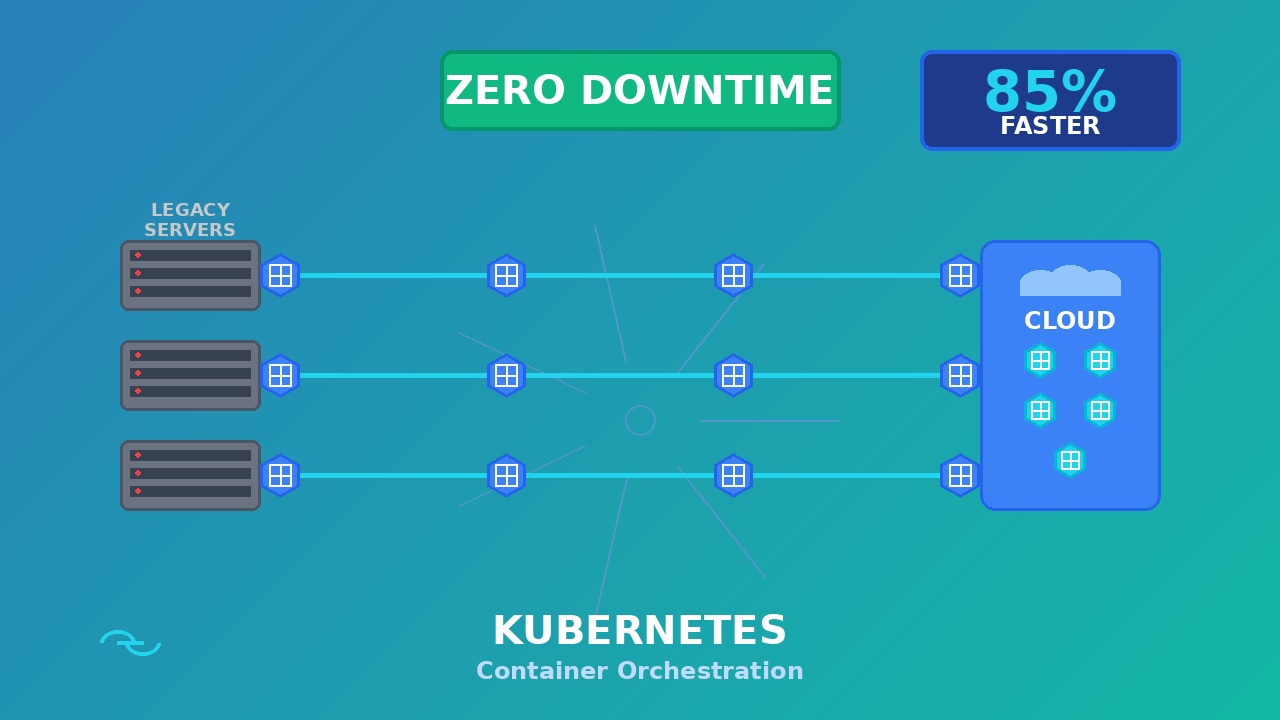
When a global e-commerce platform approached us, they were struggling with monthly release cycles that required weekend deployments and frequent production incidents. Within three months, we transformed their infrastructure, achieving 85% faster deployments and 99.8% uptime through strategic Kubernetes migration.
Transformation Summary
| Metric | Before (VMs) | After (Kubernetes) | Improvement |
|---|---|---|---|
| Deployment Time | 6-8 hours | 45 minutes | 85% faster |
| Release Frequency | Monthly | Daily | 30x more frequent |
| Deployment Success Rate | 60% | 99.5% | +39.5% |
| System Uptime | 97.2% | 99.8% | +2.6% |
| Production Incidents | 3-4/month | 0.2/month | 95% reduction |
| Weekend Deployments | Required | Zero | 100% eliminated |
| Time to Market | 3-4 months | 3-4 weeks | 75% faster |
| Infrastructure Costs | $52K/month | $40K/month | 23% savings |
Challenge
Our client, a leading e-commerce platform serving customers across three continents, faced critical operational challenges with their legacy VM-based infrastructure. Their engineering teams were trapped in a cycle of slow, risky deployments that hindered business growth.
Key Problems:
- Monthly release cycles limited their ability to respond to market demands and competitor moves
- Weekend deployments were mandatory, causing team burnout and work-life balance issues
- Frequent production incidents occurred during deployments, with an average of 3-4 outages per month
- Manual deployment processes took 6-8 hours per release, with high error rates
- Scaling challenges during peak shopping seasons resulted in performance degradation and lost revenue
The business impact was significant. Marketing campaigns had to be planned months in advance, customer-requested features took quarters to deliver, and the company was losing competitive advantage to more agile competitors. The CTO knew that modernizing their deployment infrastructure was critical to survival.
Previous attempts to improve the situation through scripting and automation had only provided marginal improvements. The fundamental architecture needed transformation.
Solution
We implemented a comprehensive Kubernetes migration strategy that prioritized safety, minimal disruption, and team enablement. Our approach focused on incremental migration rather than a risky "big bang" transformation.
Assessment and Planning (Weeks 1-2)
We began with a thorough assessment of their existing applications, identifying dependencies, performance requirements, and migration complexity. We classified applications into three categories: quick wins (stateless services), medium complexity (services with database dependencies), and high complexity (legacy monoliths).
Infrastructure Modernization (Weeks 3-6)
We established a production-grade Kubernetes cluster on their existing cloud provider (AWS) using industry best practices:
- Multi-zone deployment for high availability with automatic failover
- Horizontal Pod Autoscaling (HPA) configured for traffic-responsive scaling
- Network policies and RBAC for security isolation
- Monitoring stack with Prometheus and Grafana for comprehensive observability
Application Containerization (Weeks 4-8)
Working alongside the client's development teams, we containerized their applications systematically:
- Created optimized Docker images with multi-stage builds, reducing image sizes by 60%
- Implemented health checks and readiness probes for reliable deployments
- Configured resource limits and requests based on actual usage patterns
- Established secrets management using Kubernetes Secrets with encryption at rest
CI/CD Pipeline Implementation (Weeks 7-10)
We built automated CI/CD pipelines that eliminated manual deployment steps:
- Automated testing at every stage (unit, integration, end-to-end)
- Blue-green deployment strategy enabling instant rollbacks with zero downtime
- Automated smoke tests post-deployment to catch issues immediately
- GitOps workflows using Argo CD for declarative infrastructure management
Phased Migration (Weeks 9-12)
We executed a carefully orchestrated migration using a risk-based approach:
| Phase | Duration | Applications | Risk Level | Strategy |
|---|---|---|---|---|
| Phase 1 | Week 9 | Internal tools, monitoring | Low | Test deployment process |
| Phase 2 | Week 10 | API services, middleware | Medium | Blue-green with parallel running |
| Phase 3 | Week 11 | Customer-facing web apps | High | Gradual traffic shifting (10%→50%→100%) |
| Phase 4 | Week 12 | Core checkout & payments | Critical | Canary deployment + instant rollback ready |
Migration Approach:
- Started with non-critical services to validate the approach
- Gradually migrated customer-facing applications with comprehensive monitoring
- Maintained parallel infrastructure during transition for safe rollback capability
- Completed with zero customer-facing downtime
Throughout the process, we provided hands-on training to ensure the team could independently manage and evolve the new infrastructure.
Results
The transformation delivered exceptional business and operational outcomes that exceeded initial targets:
Deployment Performance
- 85% reduction in deployment time (6-8 hours → 45 minutes)
- Daily deployments became the norm (from monthly releases)
- Zero-downtime deployments achieved through blue-green strategy
- 95% reduction in deployment-related incidents
Operational Excellence
- 99.8% uptime achieved (up from 97.2%)
- Weekend deployments eliminated completely
- 3x faster time-to-market for new features
- Automatic scaling during traffic spikes without manual intervention
Business Impact
- $240K annual savings from reduced infrastructure overhead and improved resource utilization
- Improved developer productivity - engineering teams reported 30% more time for feature development
- Faster incident response - mean time to recovery (MTTR) reduced by 70%
- Enhanced competitive positioning through rapid feature delivery
Team Transformation
The client's engineering team gained full ownership of the Kubernetes infrastructure, with:
- 12 engineers trained and certified on Kubernetes operations
- Comprehensive documentation and runbooks created
- On-call rotation simplified due to improved system reliability
- Developer satisfaction increased significantly based on quarterly surveys
"Migrating to Kubernetes with Kapden was transformative for our business. We went from dreading releases to deploying multiple times per day with confidence. Our team's morale has never been higher, and we're finally competitive on feature velocity." — VP of Engineering
Key Takeaways
This case study demonstrates that successful cloud-native transformation requires more than technical migration—it demands cultural change, comprehensive training, and pragmatic execution:
- Incremental migration reduces risk and builds confidence
- Automation first eliminates human error and accelerates delivery
- Observability is critical for operating distributed systems effectively
- Team enablement ensures long-term success beyond the initial migration
Technologies Used
- Container Orchestration: Kubernetes (EKS), Docker
- CI/CD: GitLab CI, Argo CD, Helm
- Monitoring: Prometheus, Grafana, ELK Stack
- Security: Kubernetes RBAC, Network Policies, Sealed Secrets
- Infrastructure as Code: Terraform, Helm Charts
Ready to modernize your deployment infrastructure? Explore our Cloud Infrastructure services or contact us to discuss your Kubernetes migration strategy.
Learn more about our approach: CI/CD Pipeline Optimization | Cloud Architecture Design