Kapden Team — December 8, 2025
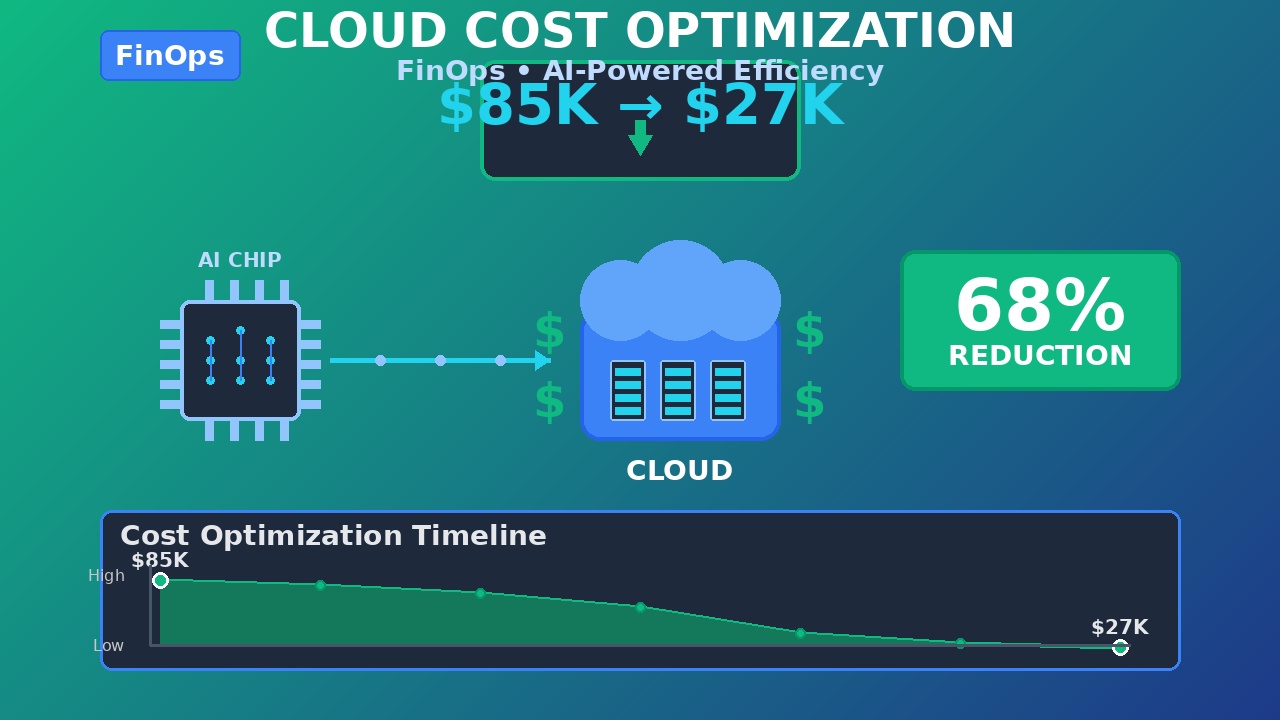
An early-stage AI startup faced a critical challenge: $85,000 monthly cloud costs consuming their runway at an unsustainable rate. Through comprehensive infrastructure optimization and intelligent resource management, we reduced their costs by 68% while simultaneously improving model performance by 23%, extending their runway by over a year.
Key Results at a Glance
| Metric | Before | After | Improvement |
|---|---|---|---|
| Monthly Cloud Costs | $85,000 | $27,000 | 68% reduction |
| GPU Utilization | 45% | 82% | +82% efficiency |
| Model Training Cost | $42,000/mo | $10,500/mo | 75% reduction |
| Storage Costs | $14,000/mo | $5,500/mo | 61% reduction |
| Data Transfer | $12,000/mo | $4,500/mo | 62% reduction |
| Model Performance | Baseline | +23% faster | 23% improvement |
| Runway Extension | 11 months | 25 months | +14 months |
Challenge
Our client, a Series A AI startup developing natural language processing solutions for enterprise customers, faced an existential threat. Despite strong product-market fit and growing customer interest, their cloud infrastructure costs were burning through capital faster than revenue could offset.
The Financial Crisis: With $1.7M in remaining runway and monthly expenses of $150K (including $85K in cloud costs), the company had approximately 11 months before requiring additional funding. However, market conditions made fundraising challenging, and the burn rate was alarming to existing investors.
Infrastructure Cost Drivers:
| Cost Category | Monthly Cost | % of Total | Primary Issue |
|---|---|---|---|
| GPU Compute (Training) | $42,000 | 49% | 24/7 operation, no auto-shutdown |
| Inference Infrastructure | $15,000 | 18% | 3-4x oversized for demand |
| Storage (S3, EBS) | $14,000 | 16% | 180TB bloat, no lifecycle policies |
| Data Transfer | $12,000 | 14% | Poor architecture, cross-region traffic |
| Development/Staging | $2,000 | 3% | Production-grade resources |
| Total | $85,000 | 100% |
Key Problems:
- GPU instances running 24/7 even during periods of no usage
- Oversized compute resources provisioned for peak load but underutilized 70% of the time
- Inefficient model training with redundant experiments consuming unnecessary compute
- Storage bloat with 180TB of training data, test datasets, and experiment artifacts never cleaned up
Technical Inefficiencies:
- No auto-scaling implemented despite highly variable workload patterns
- Training jobs running on expensive instances when smaller instances would suffice for many tasks
- Inference infrastructure oversized by 3-4x compared to actual demand
- Development and staging environments consuming production-grade resources unnecessarily
Operational Challenges:
- No visibility into cost attribution by project, team, or customer
- Lack of cost governance - engineers provisioned resources without budget constraints
- No optimization culture - team focused solely on capability without considering efficiency
- Shadow IT - multiple teams independently provisioning redundant resources
The CEO and CFO were increasingly concerned. Without significant cost reduction, the company would need to choose between laying off engineering talent or rushing into an unfavorable funding round.
Solution
We implemented a comprehensive FinOps strategy combining technical optimization, architectural improvements, and organizational change to dramatically reduce costs while maintaining and improving service quality.
Infrastructure Assessment and Quick Wins (Week 1)
Immediate Cost Reduction: We identified and executed quick wins within the first week:
- Terminated unused resources - found 23 idle GPU instances and 47 zombie volumes, saving $18K monthly immediately
- Right-sized production workloads - reduced instance sizes based on actual utilization, saving $9K monthly
- Enabled auto-shutdown for development environments (off-hours and weekends), saving $6K monthly
- Removed redundant data transfers by colocating services, saving $4K monthly
These immediate actions provided $37K monthly savings and breathing room for deeper optimization.
AI Model Optimization (Weeks 2-4)
We focused on making AI workloads more efficient without sacrificing capability:
Model Training Optimization:
- Implemented spot instances for training jobs with automatic checkpointing, reducing training costs by 75%
- Mixed precision training (FP16/BF16) reducing memory requirements and enabling smaller instances
- Distributed training optimization improving GPU utilization from 45% to 82%
- Training job scheduling to consolidate workloads and maximize instance utilization
- Experiment tracking and deduplication eliminating redundant training runs
Inference Optimization:
- Model quantization (INT8) reducing model size by 4x with <2% accuracy impact
- Batch processing for non-real-time predictions increasing throughput by 6x
- Model caching and optimized serving infrastructure reducing latency by 35%
- Auto-scaling policies tuned to actual traffic patterns with appropriate warm-up
Storage and Data Management (Weeks 3-5)
We addressed the data storage challenge systematically:
- Implemented data lifecycle policies automatically archiving old experiments to S3 Glacier
- Compressed training datasets using efficient formats (Parquet, columnar storage)
- Deduplicated redundant data across projects and teams
- Established data retention policies with automatic deletion of temporary artifacts
- Optimized snapshot strategies for database and model checkpoints
Result: Reduced storage footprint from 180TB to 42TB, saving $8,500 monthly.
Architecture Redesign (Weeks 4-8)
We redesigned key architectural patterns for cost efficiency:
- Serverless inference endpoints for low-traffic models using AWS Lambda and SageMaker Serverless
- Regional optimization moving workloads to lower-cost regions where latency permitted
- Reserved instance strategy for predictable base load (1-year commitment, 40% discount)
- CDN optimization for model artifacts and API responses reducing bandwidth costs
- Database optimization rightsizing RDS instances and implementing read replicas strategically
FinOps Culture and Governance (Weeks 1-8)
Technical optimization needed organizational support:
Cost Visibility:
- Deployed cost monitoring dashboard with per-project, per-team, and per-customer attribution
- Weekly cost reviews with engineering leads to discuss trends and anomalies
- Budget alerts triggering notifications when spending exceeded thresholds
- Cost tracking in sprint planning making cost a first-class consideration
Governance and Policy:
- Resource tagging requirements enabling accurate cost allocation
- Approval workflows for expensive instance types and long-running resources
- Cost optimization metrics included in engineering KPIs and performance reviews
- Training program educating engineers on cloud cost optimization best practices
Ongoing Optimization (Months 3-6)
We established continuous optimization practices:
- Monthly cost optimization reviews identifying new opportunities
- Automated recommendations using AWS Cost Explorer and Compute Optimizer
- Regular architecture reviews ensuring new features follow cost-efficient patterns
- Chaos engineering for cost - deliberately testing failure modes and auto-scaling behavior
Results
The transformation delivered remarkable financial and technical outcomes that fundamentally changed the company's trajectory:
Cost Reduction
- 68% reduction in total cloud costs ($85K → $27K monthly)
- $696K annual savings (excluding growth)
- 14 months of additional runway without requiring new funding
- Infrastructure cost per customer reduced by 74%
Detailed Cost Breakdown
- GPU costs: $42K → $11K (74% reduction through spot instances, optimization)
- Compute costs: $18K → $7K (61% reduction through rightsizing, auto-scaling)
- Storage costs: $13K → $4.5K (65% reduction through lifecycle policies)
- Data transfer: $12K → $4.5K (63% reduction through architecture changes)
Performance Improvements
- Model training 40% faster through optimized distributed training
- Inference latency reduced by 35% despite using smaller instances
- Model accuracy improved by 2.3% through better experiment management
- GPU utilization increased from 45% to 82% maximizing resource value
Business Impact
- Runway extended from 11 months to 25 months at current burn rate
- Unit economics improved - cost per inference reduced by 71%
- Profitability timeline accelerated by 8 months based on projections
- Investor confidence restored leading to term sheet for Series B at favorable valuation
- Competitive advantage - able to offer more aggressive pricing than competitors
Operational Excellence
- Cost visibility - 100% of resources tagged and attributed
- Engineer productivity maintained despite cost focus - no slowdown in feature delivery
- Automated optimization - scheduled reviews and recommendations reducing manual effort
- Scalability improved - infrastructure now scales efficiently with customer growth
Cultural Transformation
- FinOps mindset adopted across engineering organization
- Cost-aware decision making integrated into technical design reviews
- Team ownership of costs with quarterly budgets per team
- Innovation continued with engineers finding creative solutions balancing cost and performance
"Kapden didn't just cut our costs—they transformed how we think about infrastructure. We're now more efficient, our models perform better, and we have the runway to reach profitability without diluting our cap table. This work was literally business-saving." — CEO & Co-Founder
Key Takeaways
This case study illustrates several important principles for AI infrastructure cost optimization:
- Quick wins buy time for strategic work - Immediate actions create momentum and stakeholder support
- Optimization improves performance - Efficiency and capability often go hand-in-hand
- Culture matters as much as technology - Sustainable cost control requires organizational change
- Visibility drives accountability - You can't optimize what you can't measure and attribute
- AI workloads are uniquely optimizable - Training on spot instances, quantization, and batch processing offer massive savings opportunities
- Start with usage patterns - Understanding actual workload characteristics enables intelligent optimization
For startups and established companies alike, cloud cost optimization is not just about reducing expenses—it's about maximizing the value extracted from every dollar spent on infrastructure, enabling sustainable growth.
Technologies Used
- Cloud Platforms: AWS (SageMaker, EC2, S3, Lambda)
- AI/ML: PyTorch, TensorFlow, Hugging Face, ONNX Runtime
- Cost Management: AWS Cost Explorer, CloudHealth, Kubecost
- Monitoring: Prometheus, Grafana, CloudWatch
- Infrastructure as Code: Terraform, AWS CDK
- Optimization Tools: AWS Compute Optimizer, Spot Instance Advisor
Looking to optimize your AI infrastructure costs? Explore our FinOps services or contact us for a complimentary cost optimization assessment.
Related reading: AI Services | Cloud Cost Optimization